


How to stop catastrophic thinking is a question many people ask when anxious thoughts start taking over. Catastrophic thinking occurs when your mind jumps to worst-case scenarios, leading to unnecessary worry and stress. These automatic negative thoughts can make daily life feel overwhelming.
The good news is that you can calm anxious thinking by recognizing these patterns, challenging them, and using practical strategies like mindfulness, journaling, and cognitive exercises. Simple lifestyle habits like regular exercise, quality sleep, and connecting with supportive people also reduce mental overwhelm.
By learning to reframe your thoughts and break the cycle of rumination, you can regain control, stop anxiety spirals, and feel more grounded in your daily life.
Identify Your Catastrophic Thoughts
Stopping catastrophic thinking starts with recognizing it. Often, these thoughts happen automatically, making your mind jump to worst-case scenarios without warning. By noticing these patterns, you can begin to break the cycle of anxious thinking and take control of your mental well-being. Awareness is the first step toward change.
Recognizing Automatic Negative Thoughts
Automatic negative thoughts are the sudden “what if” ideas that fuel anxiety. You might imagine the worst possible outcome in everyday situations, even when there’s no evidence that it will happen. Paying attention to these thoughts helps you understand your mind’s patterns and the triggers that make them appear.
Writing Down Your Worries
Keeping a journal of your worries can be a powerful tool. Write down each thought as it comes, noting what triggered it and how it makes you feel. This exercise breaks overwhelming thoughts into manageable pieces, making it easier to see patterns over time.
Identifying Triggers and Patterns
Certain situations, people, or times of day can trigger catastrophic thinking. By tracking your thoughts, you can identify these triggers. Once you know what sparks your anxious thinking, you can plan strategies to respond differently, like taking deep breaths, grounding yourself, or using positive self-talk.
Identifying catastrophic thoughts is a crucial first step. Awareness, journaling, and recognizing triggers allow you to challenge negative patterns and start practicing techniques that reduce anxiety, helping you regain control of your mind.
Challenge and Reframe Your Thoughts
Once you’ve identified catastrophic thinking, the next step is to challenge and reframe those thoughts. This helps you break the cycle of anxious thinking and prevents your mind from automatically jumping to worst-case scenarios. Learning to question your thoughts builds mental resilience and reduces stress.
Questioning the Evidence
When a catastrophic thought arises, ask yourself: “What evidence do I have that this will actually happen?” Often, you’ll find that worst-case scenarios are unlikely. By examining the facts rather than assumptions, you can see the situation more clearly and reduce unnecessary worry.
Using “What If” Positively
Instead of letting “what if” thoughts spiral, turn them into productive questions. For example, ask, “What can I do if this happens?” This shifts your focus from fear to practical solutions, giving you a sense of control over the situation.
Replacing Worst-Case Scenarios with Realistic Outcomes
Write down a more realistic version of the situation. Replace catastrophic predictions with outcomes that are likely or manageable. This reframing helps train your mind to think rationally rather than emotionally, reducing the intensity of anxious thoughts over time.
Challenging and reframing thoughts is a practical way to stop catastrophic thinking by questioning evidence, using the “what if” constructively, and imagining realistic outcomes. You can regain control of your mind and reduce anxiety effectively.
Mindfulness and Relaxation Techniques
Practicing mindfulness and relaxation techniques can be very effective in stopping catastrophic thinking. These methods help you stay present and calm, and reduce anxiety. By focusing on the current moment, you can prevent your mind from spiraling into worst-case scenarios and regain control over your thoughts.

Deep Breathing and Meditation
Simple deep breathing exercises slow your heart rate and calm your nervous system. Try inhaling slowly for four counts, holding for four, and exhaling for four. Meditation, even for a few minutes a day, can train your mind to observe thoughts without reacting to them, reducing mental overwhelm.
Grounding Exercises to Stay Present
Grounding techniques help you focus on the present rather than imagined catastrophes. For example, notice five things you can see, four you can touch, three you can hear, two you can smell, and one you can taste. This exercise shifts attention away from anxious thinking and brings mental clarity.
Progressive Muscle Relaxation
Tensing and relaxing muscle groups from head to toe releases physical tension that often accompanies catastrophic worry. This practice also makes you more aware of stress in your body, helping you address it before it escalates into anxiety.
Incorporating mindfulness and relaxation into your daily routine gives you tools to interrupt catastrophic thinking. Regular practice reduces anxiety, improves focus, and strengthens your ability to respond calmly to challenging thoughts.
Mindfulness and Relaxation Techniques
Practicing mindfulness and relaxation techniques can be very effective in stopping catastrophic thinking. These methods help you stay present and calm and reduce anxiety. By focusing on the current moment, you can prevent your mind from spiraling into worst-case scenarios and regain control over your thoughts.
Deep Breathing and Meditation
Simple deep breathing exercises slow your heart rate and calm your nervous system. Try inhaling slowly for four counts, holding for four, and exhaling for four. Meditation, even for a few minutes a day, can train your mind to observe thoughts without reacting to them, reducing mental overwhelm.
Grounding Exercises to Stay Present
Grounding techniques help you focus on the present rather than imagined catastrophes. For example, notice five things you can see, four you can touch, three you can hear, two you can smell, and one you can taste. This exercise shifts attention away from anxious thinking and brings mental clarity.
Progressive Muscle Relaxation
Tensing and relaxing muscle groups from head to toe releases physical tension that often accompanies catastrophic worry. This practice also makes you more aware of stress in your body, helping you address it before it escalates into anxiety.
Incorporating mindfulness and relaxation into your daily routine gives you tools to interrupt catastrophic thinking. Regular practice reduces anxiety, improves focus, and strengthens your ability to respond calmly to challenging thoughts.
Mindfulness and Relaxation Techniques
Practicing mindfulness and relaxation techniques can be very effective in stopping catastrophic thinking. These methods help you stay present andcalm, and reduce anxiety. By focusing on the current moment, you can prevent your mind from spiraling into worst-case scenarios and regain control over your thoughts.
Deep Breathing and Meditation
Simple deep breathing exercises slow your heart rate and calm your nervous system. Try inhaling slowly for four counts, holding for four, and exhaling for four. Meditation, even for a few minutes a day, can train your mind to observe thoughts without reacting to them, reducing mental overwhelm.
Grounding Exercises to Stay Present
Grounding techniques help you focus on the present rather than imagined catastrophes. For example, notice five things you can see, four you can touch, three you can hear, two you can smell, and one you can taste. This exercise shifts attention away from anxious thinking and brings mental clarity.
Progressive Muscle Relaxation
Tensing and relaxing muscle groups from head to toe releases physical tension that often accompanies catastrophic worry. This practice also makes you more aware of stress in your body, helping you address it before it escalates into anxiety.
Incorporating mindfulness and relaxation into your daily routine gives you tools to interrupt catastrophic thinking. Regular practice reduces anxiety, improves focus, and strengthens your ability to respond calmly to challenging thoughts.
Cognitive Behavioral Tools and Resources
Cognitive behavioral tools are highly effective for stopping catastrophic thinking. They help you notice, challenge, and change negative thought patterns. Using these tools regularly strengthens your mind, reduces anxious thinking, and gives you practical strategies to handle stress and worry in everyday life.
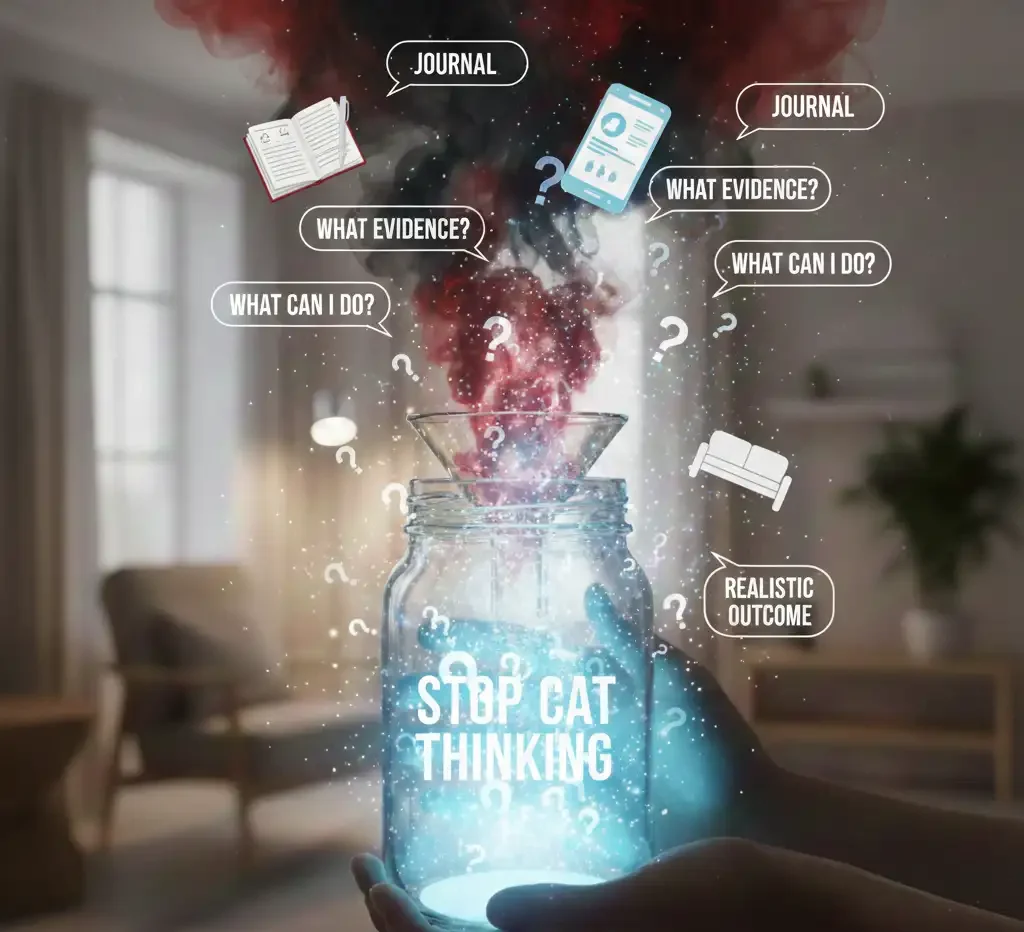
Journaling and Thought Records
Writing down your thoughts is a simple but powerful tool. Keep a journal of when catastrophic thoughts arise, what triggered them, and how they made you feel. Thought records help you see patterns over time. When you write your thoughts down, it becomes easier to challenge them and reframe them more realistically.
CBT Exercises for Catastrophic Thinking
Cognitive Behavioral Therapy (CBT) exercises are designed to replace automatic negative thoughts with balanced and rational thinking. Examples include listing evidence for and against a thought, evaluating the likelihood of worst-case scenarios, and imagining realistic outcomes. Doing these exercises regularly helps train your brain to think more clearly and reduce anxiety.
Apps and Therapy Options
Several apps provide guided CBT exercises, relaxation practices, and mindfulness reminders. If catastrophic thinking feels overwhelming, a licensed therapist can provide personalized strategies. Therapy combines CBT techniques with support, helping you develop lasting skills to manage anxious thoughts and regain control over your mind.
By using cognitive-behavioral tools such as journaling, structured CBT exercises, and professional guidance, you can actively reduce catastrophic thinking. These strategies offer practical ways to calm racing thoughts, reframe negative patterns, and build mental resilience.
When to Seek Professional Help
While many strategies can reduce catastrophic thinking, sometimes professional support is necessary. Recognizing when to seek help ensures your mental health is protected and prevents anxiety from interfering with daily life. Therapy and counseling provide guidance, tools, and support to manage persistent or overwhelming thoughts.
Signs Catastrophic Thinking Is Impacting Daily Life
If your anxious thoughts prevent you from working, sleeping, or enjoying relationships, it’s a signal to reach out for help. Other warning signs include constant worry, physical tension, panic attacks, or difficulty making decisions due to fear of worst-case scenarios.
How Therapists and Counselors Can Help
Mental health professionals use techniques such as cognitive-behavioral therapy (CBT) to target catastrophic thinking. They teach practical tools for challenging automatic negative thoughts, reframing worst-case scenarios, and reducing rumination. Professional support also provides accountability, guidance, and personalized strategies that are difficult to implement on your own.
When to Combine Therapy With Lifestyle Changes
Combining therapy with lifestyle habits such as mindfulness, exercise, proper sleep, and journaling enhances results. A therapist can help integrate these practices into daily life, ensuring you build long-term resilience against anxious and catastrophic thinking.
Seeking professional help does not mean failure; it is a proactive step toward mental clarity. With guidance, you can manage catastrophic thoughts more effectively, reduce anxiety, and regain control of your mind and daily life.
Conclusion: Regaining Control Over Your Thoughts
Stopping catastrophic thinking requires awareness, practice, and patience. By identifying negative thought patterns and challenging them, you can reduce anxiety and take control of your mind. Regularly using tools like journaling, CBT exercises, and mindful breathing helps train your brain to replace automatic negative thoughts with realistic ones.
Lifestyle habits such as exercise, quality sleep, healthy nutrition, and supportive relationships also reduce mental overwhelm. Social support gives perspective, while healthy routines prevent anxious thoughts from spiraling.
Remember, occasional anxious thoughts are normal. The goal is progress, not perfection. By combining awareness, practical strategies, and self-compassion, you can stop catastrophic thinking, respond calmly to challenges, reduce anxiety, and live with more control and peace.
FAQ
What is catastrophic thinking, and how does it affect mental health?
Catastrophic thinking is when your mind jumps to worst-case scenarios, creating stress, anxiety, and mental overwhelm.
How can I quickly stop catastrophic thinking?
Use strategies like journaling, thought challenging, mindfulness, grounding exercises, and CBT techniques.
Are lifestyle changes effective in reducing catastrophic thinking?
Yes. Exercise, quality sleep, healthy nutrition, and supportive social connections can lower anxiety and prevent worry spirals.
When should I seek professional help for catastrophic thoughts?
If anxiety interferes with daily life, causes panic, or prevents sleep, consult a therapist or mental health professional.
Can meditation or deep breathing really help with catastrophic thinking?
Yes. Mindfulness and relaxation techniques calm the mind, reduce racing thoughts, and help you respond more rationally.
